

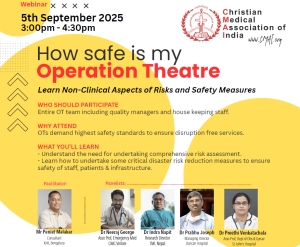
Building Safer Operation Theatres: Key Insights from CMAI's Disaster Resilient Hospitals Webinar
The Christian Medical Association of India (CMAI) successfully conducted the second webinar in their Disaster Resilient Hospitals Series on September 5, 2025, focusing on non-clinical safety risks in operation theatres. Moderated by Dr Abhijeet Sangma and facilitated by disaster management expert Mr Peniel Malakar, the session brought together healthcare professionals from India and Nepal to address critical safety gaps beyond traditional clinical protocols.
The distinguished panel shared powerful real-world experiences that highlighted both vulnerabilities and solutions.
The discussion addressed specific challenges facing mission hospitals with aging infrastructure and limited budgets. Experts identified the top three non-clinical risks as electrical system failures from overloaded circuits, inadequate backup power systems, and poor evacuation planning with insufficient staff training. For immediate low-cost improvements, they recommended regular equipment maintenance, staff training and drills, systematic risk assessment, and proper emergency supply placement.
For overwhelmed hospital administrators, the panel emphasized starting with comprehensive risk assessment, prioritizing operation theatre and backup systems, investing in training before expensive infrastructure, and focusing on one critical area at a time. All panellists stressed that training and regular drills represent the most cost-effective initial investments, creating a safety culture that prevents disasters more effectively than expensive equipment alone.
The webinar concluded with practical takeaways: immediate operation theatre safety walk-throughs to identify risks, verification of fire extinguisher and backup power functionality, establishment of incident reporting systems, completion of comprehensive risk assessments within three months, and commitment to ongoing monthly drills and quarterly equipment checks.
The session successfully demonstrated that operation theatre safety requires a holistic approach encompassing structural, electrical, environmental, and human factors. The shared experiences proved that while disasters can strike any facility, proper preparation significantly mitigates impact and ensures continued patient care during crises. As mission hospitals face increasing regulatory scrutiny, this webinar provided practical, resource-conscious approaches to building resilient operation theatres.
This successful instalment in CMAI's series will continue with future sessions on ICUs, pharmacies, and other critical hospital areas, maintaining CMAI's commitment to building comprehensive disaster resilience across Christian healthcare institutions. The key message resonated clearly: every life saved in operation theatres depends not just on surgical skill, but on the invisible safety net that keeps these facilities operational when disasters strike.
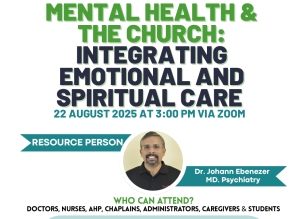
Mental health challenges have reached unprecedented levels globally, yet there exists a significant gap between clinical mental health services and spiritual care within faith communities. This webinar addressed the pressing need, recognising that mental health and spiritual wellbeing are intrinsically connected aspects of human experience that require integrated approaches. The importance of this topic stems from the historical reality that psychology and psychiatry originally emerged from philosophical and theological traditions. The Greek word "psyche," meaning soul, forms the root of both psychology and psychiatry, highlighting that these disciplines were once integrated with spiritual care rather than separated from it. Today's divide between mental health professionals and faith communities has created a vacuum in holistic care, particularly affecting Christian families and congregations. The webinar distinguished itself through an innovative approach using role-play scenarios to demonstrate real-world applications of integrated care. Dr Johann Ebenezer and his interdisciplinary team from healthSoch Academy portrayed a fictional but representative Christian family facing substance abuse challenges.
This dramatic presentation made abstract concepts tangible, allowing participants to witness family dynamics, communication patterns, and intervention strategies in action. The role-play effectively illustrated how theoretical principles translate into practical caregiving situations.
Webinar Synopsis
Dr Johann began by establishing the historical integration of theology, philosophy, and psychology in early Christian tradition. He explained how the separation of these disciplines over the past 150 years has created current tensions between faith communities and mental health professionals.
The central drama portrayed a pastor's family dealing with their son's substance abuse, revealing multiple layers of dysfunction:
The webinar demonstrated how mental health professionals can work with Christian families while respecting both clinical best practices and biblical principles. Key elements included:
Key Takeaway Points
1. Reclaim Historical Integration
The church must recognize that soul care (mental health) was historically within its mandate and expertise. Modern separation is artificial and counterproductive.
2. Address Family Dynamics First
Many mental health issues in Christian contexts stem from compromised family structures. Addressing parental roles, consistency, and family spiritual practices is foundational.
3. Father's Critical Role
Research confirms biblical principles regarding fathers' crucial role in child development, particularly during adolescence. Absent or passive fathers correlate with increased substance abuse, mental illness, and behavioural problems.
4. Consistent Messaging Required
All caregivers must align on core principles and boundaries. Mixed messages undermine treatment effectiveness and family stability.
5. Integration, Not Separation
Mental health professionals and spiritual caregivers should work collaboratively rather than in isolation, each contributing their expertise while respecting the other's domain.
6. Practical Implementation
Churches can integrate mental health awareness through leader training, addressing relevant topics in existing ministries, and returning to substantive biblical teaching that addresses life's challenges.
7. Christian Worldview Foundation
When working with Christian families, interventions should align with biblical principles regarding family structure, discipline, forgiveness, and restoration while maintaining clinical effectiveness. The webinar demonstrated that mental health and spiritual care are not competing approaches but complementary aspects of holistic human flourishing. The innovative use of role-play made complex concepts accessible and provided a model for future training initiatives in this critical area of integrated care.
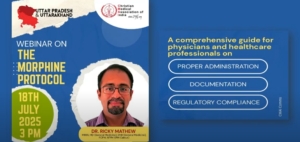
The webinar on "The Morphine Protocol," organised by CMAI UP & Uttarakhand Region and Doctors Section, featured Dr Ricky Mathew, Medical Superintendent of Broadwell Christian Hospital in Fatehpur, UP, as the main speaker. Rev Sumit David served as host and Dr Abhijeet Sangma as the moderator for this well-attended session, which attracted 243 unique Zoom logins. About 150 participants remained for over 15 minutes, 110 for more than 30 minutes, and 65 stayed beyond the 45-minute mark, demonstrating sustained interest despite some expected attrition.
Dr Ricky Mathew, who holds numerous medical qualifications including MBBS, MD General Medicine, and specialised Palliative care training, shared his extensive experience in delivering palliative care to nearly 800 patients with advanced and life-limiting illnesses.
The presentation covered the historical context of morphine as a pain management tool, including its derivation from the poppy plant and India's position as a major producer. Dr Ricky explained the evolution of the regulatory framework from the restrictive NDPS Act of 1985 to the more accessible amendments made in 2014, which established the Recognized Medical Institutions (RMIs) framework and simplified licensing procedures.
The presentation touched on fundamental palliative care concepts, particularly highlighting Dame Cicely Saunders' Total Pain Concept, which addresses physical, social, emotional, and spiritual dimensions of suffering. Dr Ricky also outlined the WHO Analgesic Ladder approach to pain management, emphasising the principles of "by the clock," "by the mouth," and "by the ladder" in administering pain relief.
The discussion segment following the presentation proved particularly engaging. When asked about challenges in becoming an RMI, Dr Ricky Mathew acknowledged that bureaucratic hurdles exist but emphasised that the process has become more straightforward since the 2014 amendment. He shared his personal experience of obtaining an RMI license within 3-4 months, noting the valuable support provided by Pallium India, which helped connect his institution with the appropriate authorities. Regarding the renewal process, Dr Ricky Mathew indicated it had been relatively smooth, though he mentioned occasional interruptions in morphine supply due to raw material issues.
A significant portion of the Q&A focused on practical strategies for managing morphine's side effects. Dr Ricky stressed the importance of proper patient counseling, explaining that preparing patients for potential side effects like nausea, vomiting, sedation, and constipation is crucial for compliance. He described how his team maintains phone availability for patients from rural areas who cannot easily travel for follow-up visits, allowing them to address side effects promptly and prevent treatment discontinuation.
When asked about special considerations for patients with comorbidities, Dr Ricky recommended starting with lower doses and reduced frequency for elderly patients and those with renal impairment, gradually titrating upward based on pain relief adequacy and side effect monitoring. This approach, he explained, helps prevent adverse effects that might cause patients to reject further treatment.
When asked about implementing the Total Pain Concept in practice, Dr Ricky described how his palliative care team conducts 4-5 home visits daily, spending significant time with patients who are often isolated in their communities. He shared moving accounts of team members sitting on the floor beside patients in thatched huts, offering empathy and attention to people who may have been neglected by their communities due to their illness. "Many of them just burst out in tears and say, 'thank you for asking,'" he noted, explaining how simply acknowledging patients' suffering provides significant relief. The team also uses these visits as opportunities for community education, particularly about tobacco cessation, given the prevalence of oral cancers in the region.
The webinar concluded with information about CMAI's upcoming biennial conference in November in Kochi, Kerala, and participants were encouraged to provide feedback for future educational offerings. The comprehensive discussion demonstrated not only the technical aspects of morphine administration but also emphasised the holistic, compassionate approach that defines effective palliative care.
CMAI
A-3, Local Shopping Centre, Janakpuri,
New Delhi - 110058, India
HVS Court, 3rd Floor
21 Cunningham Road
Bangalore – 560052,
Karnataka
CMAI
Christian Council Campus
NCCI Road, Civil Lines
Nagpur – 440001
Maharashtra