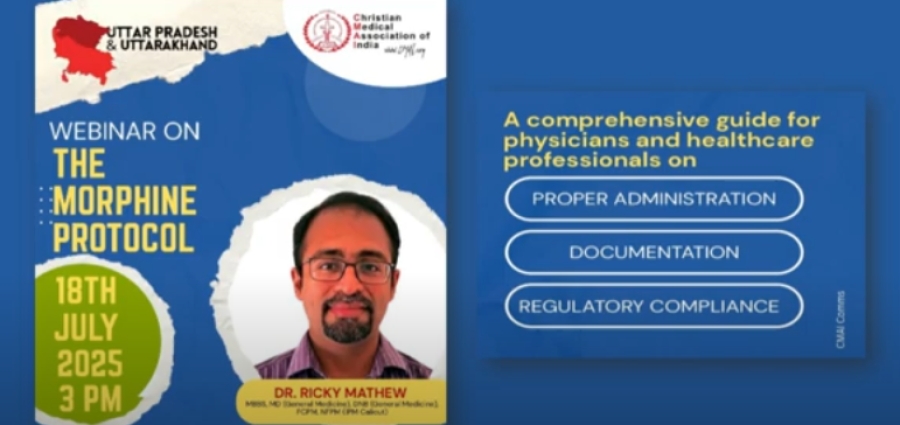

The webinar on "The Morphine Protocol," organised by CMAI UP & Uttarakhand Region and Doctors Section, featured Dr Ricky Mathew, Medical Superintendent of Broadwell Christian Hospital in Fatehpur, UP, as the main speaker. Rev Sumit David served as host and Dr Abhijeet Sangma as the moderator for this well-attended session, which attracted 243 unique Zoom logins. About 150 participants remained for over 15 minutes, 110 for more than 30 minutes, and 65 stayed beyond the 45-minute mark, demonstrating sustained interest despite some expected attrition.
Dr Ricky Mathew, who holds numerous medical qualifications including MBBS, MD General Medicine, and specialised Palliative care training, shared his extensive experience in delivering palliative care to nearly 800 patients with advanced and life-limiting illnesses.
The presentation covered the historical context of morphine as a pain management tool, including its derivation from the poppy plant and India's position as a major producer. Dr Ricky explained the evolution of the regulatory framework from the restrictive NDPS Act of 1985 to the more accessible amendments made in 2014, which established the Recognized Medical Institutions (RMIs) framework and simplified licensing procedures.
The presentation touched on fundamental palliative care concepts, particularly highlighting Dame Cicely Saunders' Total Pain Concept, which addresses physical, social, emotional, and spiritual dimensions of suffering. Dr Ricky also outlined the WHO Analgesic Ladder approach to pain management, emphasising the principles of "by the clock," "by the mouth," and "by the ladder" in administering pain relief.
The discussion segment following the presentation proved particularly engaging. When asked about challenges in becoming an RMI, Dr Ricky Mathew acknowledged that bureaucratic hurdles exist but emphasised that the process has become more straightforward since the 2014 amendment. He shared his personal experience of obtaining an RMI license within 3-4 months, noting the valuable support provided by Pallium India, which helped connect his institution with the appropriate authorities. Regarding the renewal process, Dr Ricky Mathew indicated it had been relatively smooth, though he mentioned occasional interruptions in morphine supply due to raw material issues.
A significant portion of the Q&A focused on practical strategies for managing morphine's side effects. Dr Ricky stressed the importance of proper patient counseling, explaining that preparing patients for potential side effects like nausea, vomiting, sedation, and constipation is crucial for compliance. He described how his team maintains phone availability for patients from rural areas who cannot easily travel for follow-up visits, allowing them to address side effects promptly and prevent treatment discontinuation.
When asked about special considerations for patients with comorbidities, Dr Ricky recommended starting with lower doses and reduced frequency for elderly patients and those with renal impairment, gradually titrating upward based on pain relief adequacy and side effect monitoring. This approach, he explained, helps prevent adverse effects that might cause patients to reject further treatment.
When asked about implementing the Total Pain Concept in practice, Dr Ricky described how his palliative care team conducts 4-5 home visits daily, spending significant time with patients who are often isolated in their communities. He shared moving accounts of team members sitting on the floor beside patients in thatched huts, offering empathy and attention to people who may have been neglected by their communities due to their illness. "Many of them just burst out in tears and say, 'thank you for asking,'" he noted, explaining how simply acknowledging patients' suffering provides significant relief. The team also uses these visits as opportunities for community education, particularly about tobacco cessation, given the prevalence of oral cancers in the region.
The webinar concluded with information about CMAI's upcoming biennial conference in November in Kochi, Kerala, and participants were encouraged to provide feedback for future educational offerings. The comprehensive discussion demonstrated not only the technical aspects of morphine administration but also emphasised the holistic, compassionate approach that defines effective palliative care.