
Series: Understanding Practical Bioethics (Session 2)
Organised by Christian Medical Association of India (CMAI) in partnership with The Centre for Bioethics and CIHSR, Dimapur
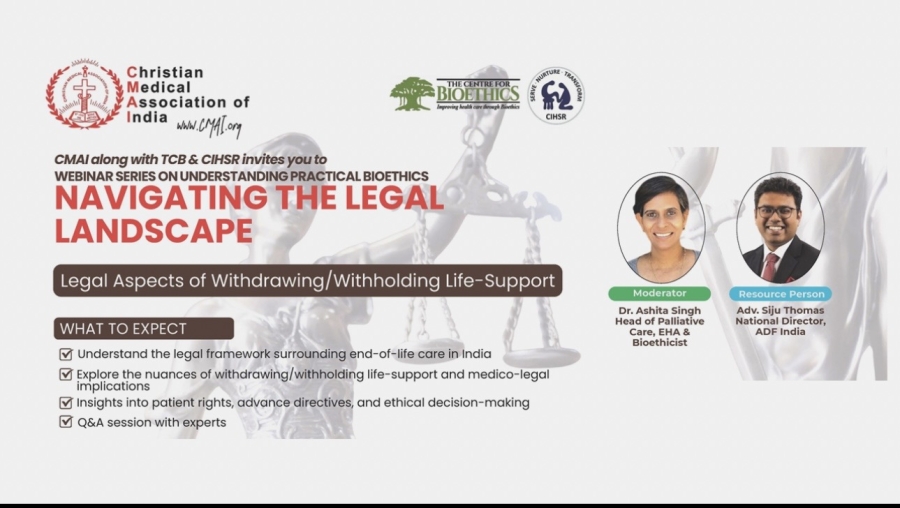
The Christian Medical Association of India (CMAI) successfully conducted the second session of its ongoing webinar series, "Understanding Practical Bioethics," on April 9, 2026. Following the foundational ethical discussions of Session 1, this webinar focused on the "Legal How," titled: "Navigating the Legal Landscape: Legal Aspects of Withdrawing/Withholding Life-Support."
The session was hosted by Dr Abhijeet Sangma (Secretary, Doctors Section, CMAI) and opened with a word of prayer by Dr Roopa Verghese (Executive Director, Centre for Bioethics)
It is noted that while the ethics of dignity and reducing futile suffering are clear, healthcare providers often encounter a "wall of legal uncertainty." This session aimed to provide the legal clarity needed to practice with confidence and compassion.
The resource person, Advocate Siju Thomas (National Director, ADF India), provided a comprehensive overview of Indian jurisprudence, specifically focusing on the recent Harish Rana judgment.
Core discussion points included:
Terminological Shift: The Court has moved away from the term "passive euthanasia," viewing it as obsolete. The focus is now strictly on the "withdrawal or withholding of medical treatment."
Constitutional Basis: These decisions are rooted in Article 21, where the right to live with dignity is legally understood to include the right to die with dignity.
The "Twin Test": For incompetent patients, decisions must qualify as medical treatment and be strictly in the patient's best interest.
Advanced Medical Directives (AMD): Adv. Siju detailed the process for "Living Wills," noting they must be made voluntarily by an adult of sound mind, attested by two witnesses, and authenticated by a notary or gazetted officer.
Medical Boards: The session clarified the streamlined process for constituting Primary and Secondary Medical Boards within 48 hours to prevent bureaucratic delays.
Duty of Care: The law clarifies that a doctor’s duty does not include an obligation to continue treatment ad infinitum when it is no longer beneficial.
The webinar saw active participation from 100 attendees, reflecting a diverse cross-section of the healthcare community:
50% Nurses: Highlighting the integral role of nursing staff in bedside ethical assessments.
25% Doctors: Engaging with the medico-legal safeguards of their practice.
25% Allied Health Professionals (AHP), Hospital Administrators, and Chaplains.
The session concluded with a vibrant discussion moderated by Dr Ashita Rebecca Singh (Head of Palliative Care, EHA), who emphasized the importance of shared decision-making between medical teams and families rather than placing the entire burden of "discharge against medical advice" on the kin.
This was the second session in the series. CMAI remains committed to equipping healthcare workers with the tools to navigate these complex scenarios.
Next Session:
Topic: Ethical Considerations for End‑of‑Life Care in Neurological Diseases
Tentative Date: May 14, 2026
Resource Person: Dr. Jeyaraj Pandian (Principal, CMC Ludhiana)